A Power Made Perfect in Weakness
The Song at the Scaffold and Little Souls

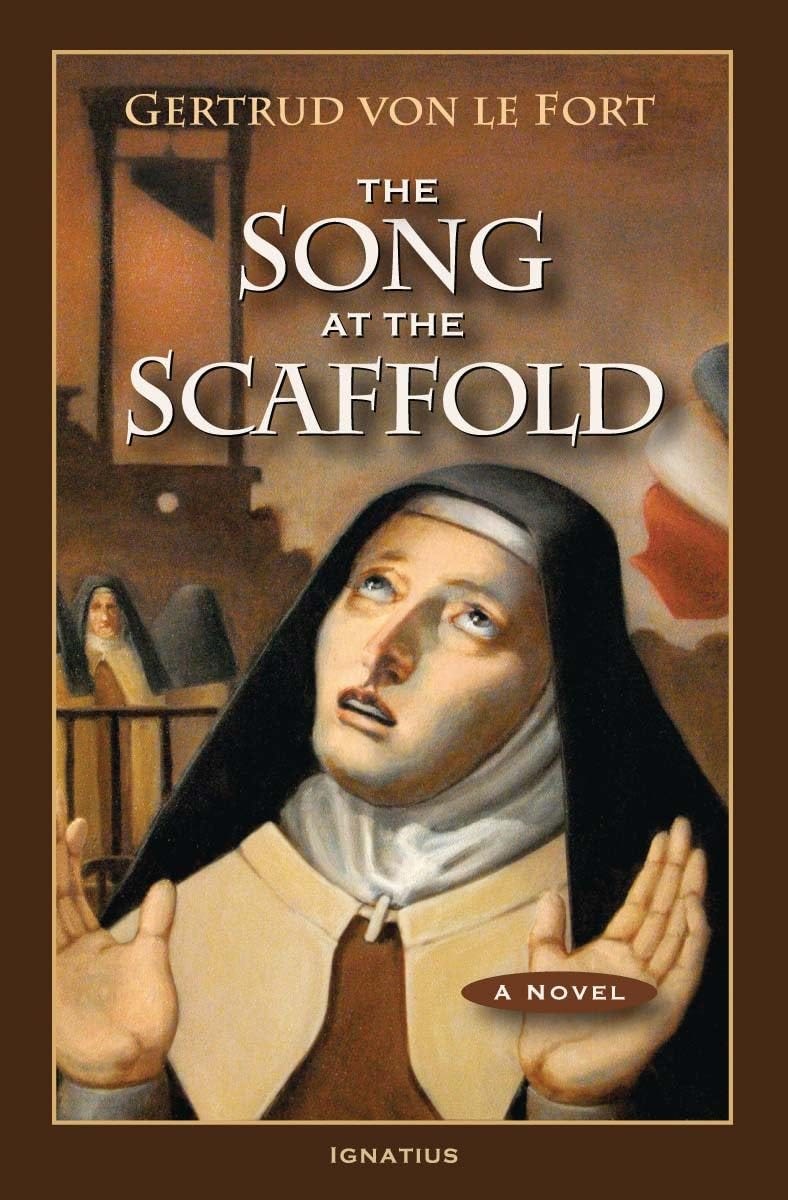
Sometimes, everything I happen to read—novels, essays, and spiritual books—seems to coalesce around a particular theme. In a matter of weeks, I encountered the Carmelites of Compiègne, who were martyred during the Reign of Terror, in three different places.
In his do-it-yourself retreat entitled Consoling the Heart of Jesus, Father Michael E. Gaitley tells the story of certain “super-nuns” of the Carmelite order who asked God to lay on them the punishment due to poor sinners as an offering to His Divine Justice. “Amazingly,” Father Gaitley writes, “the Lord accepted such deals.” These “big souls” would then fall ill and/or suffer greatly, offering their pains to God for the sinners’ conversion. Gaitley goes on to quote St. Thérèse of Lisieux’s mic-drop response more than a century later:
This offering seemed great and very generous to me, but I was far from feeling attracted to making it.
Wow. If a great Carmelite saint like Thérèse could feel this way, perhaps there is hope for a lover of comfort like me! St. Thérèse suffered much from her illness during her short life. But instead of making this offering to Divine Justice, she chose the soaringly beautiful Offering to Merciful Love, which is found in The Story of a Soul and quoted by Father Gaitley:
If Your Justice loves to release itself, this Justice which extends only over the earth, how much more does Your Merciful Love desire to set souls on fire since Your Mercy reaches to the heavens? O my Jesus, let me be this happy victim; consume Your holocaust with the fire of Your Divine Love! (emphasis in original).
I find this very consoling. As I have written before, certain offerings naturally fit our charisms better than others. To me, the Offering to Merciful Love feels like a much easier yoke to carry.
The Song at the Scaffold by Gertrud von Le Fort made me reflect on what it means to be a “little soul” after the example of St. Thérèse of Lisieux. In this short novel, Blanche de la Force is born early after her pregnant mother is dragged from her carriage when her panicked horse plunges into a crowd. This omen casts a long shadow over Blanche: “the great fear in her childish gaze penetrated the firm exterior of a sheltered life to a core of terrible frailty.” Blanche seeks constant reassurance that the very stairs of her home will not collapse under her feet. And while Blanche finds protectors and guides in the Carmelite order, she will never be entirely free of her fear. Her novice mistress, Sister Marie, will eventually say,
“Must fear and horror always be evil? Is it not possible that they may be deeper than courage, something that corresponds far more to the reality of things, to the terrors of the world, and to our own weakness?”
Sister Marie is herself a “great soul,” the natural daughter of a prince who longs to die as a martyr for the salvation of France. But while Sister Marie fears that her offering has been rejected by God, Blanche’s name in religion, “Jésus au Jardin de l’Agonie,” unites her to Christ’s mortal dread in the garden of Gethsemane. Blanche’s story calls to mind St. Paul’s second letter to the Corinthians, where he begs the Lord to remove a thorn from his side: “And He has said to me, ‘My grace is sufficient for you, for power is perfected in weakness.’” In her weakness and littleness, Blanche epitomizes the “little way” of Saint Thérèse de Lisieux.
In the end, even the “great souls” of the Carmelite order must abandon themselves to whatever use God will choose to make of their sacrifice. In his recent essay marking the feast of the newly canonized Carmelites of Compiègne, Donald Jacob Uitvlegt offers this interpretation:
Ten days after the martyrdom, the Reign of Terror came to an end with the execution of Robespierre on July 28, 1794. Though the struggle of the Church in France was by no means over, one wonders if the blood of the martyrs again was the seed of the Church, for in the nineteenth century, one finds such glories in French Catholicism as St Jean Vianney, St Bernadette Soubirous, St Théophane Vénard, and St Thérèse of Lisieux.
Mic drop, indeed. Holy Carmelite martyrs of Compiègne and Saint Thérèse of Lisieux, pray for us!